One of only three similar finds in Manitoba
31,848 BCE
What’s the oldest thing you’ve ever seen? If you’ve ever visited the Moncur Gallery in Boissevain you may have seen an artifact that's over 33,000 years old.
Discovering an Age-old Artifact
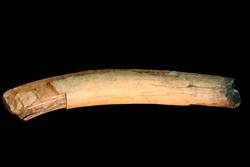
One day in 1981 local dairy farmer Larry Black was removing gravel from a municipal gravel pit on the northern slope of Turtle Mountain, 22 km southwest of Boissevain. While excavating in the pit he discovered a large white, curved object protruding from the gravel. The artifact was identified as a fossilized tusk from a proboscidean animal – either mammoth or mastodon (see below), though a specific identification wasn’t possible.
When the tusk was first unearthed it was white. After several days of being exposed to air it began to discolour and turn “flaky.” At Brandon University it was coated with white glue to preserve it.
The tusk gently curves along its 2 foot (61 cm) length and is 3.7 inches (9.5 cm) in diameter at its thickest point. One end is rounded and blunt, which suggests that the tusk was broken off before the death of the animal. Based on the size of the tusk and its lack of taper, it likely belonged to a mature female.
From BEFORE the Last Ice Age
At first it was expected that the tusk would date back to the last ice age, but in fact the tusk was radiocarbon dated to 33,860 years ago – this meant that the animal would have lived ten thousand years before the advance of the last ice age. Artifacts such as these are incredibly rare, because the advance and departure of glaciers over North America rearranged the landscape and usually washed away or covered up such evidence. The tusk is from the middle of the Middle Wisconsonian era—the non-glacial period before the last glacial advance, extending from 23,000 to 65,000 years ago. The climate during this era was slightly cooler than at present.
There is some mystery surrounding the tusk and how it came to be where it was. The fact that the tusk was the only fossil found at the location indicates that it was carried some distance by a stream. But though it was discovered in a gravel bed that was part of an ancient stream deposit, the tusk itself does not show signs of being abraded.
Hypotheses
There are several possible interpretations for how the tusk came to be where it was found: a) the animal died near the area of discovery, and only the tusk, made of dentin, a dense and more durable material, survived the fossilization process; b) the animal's remains were fossilized elsewhere some time before glacial advance, and later a melt-water stream transported the tusk, more buoyant compared to other bones; c) the tusk, being large and relatively strong, was the only part of the skeleton that remained in the location where it was found, with other bones scattered by scavengers or erosion.
This find is one of only eight proboscidean discoveries in Manitoba and one of three tusks, the other finds being teeth. It is one of only a few artifacts dating from the Middle Wisconsonian era in Canada. It confirms earlier findings in the Medicine Hat area that suggest large mammals roamed the southern prairie provinces during this period.
Mammoth vs Mastodon
The term “proboscidea” refers to an order of animal identification that includes living and extinct elephant families. Mastodons and mammoths are two different species of ancient elephants. The difference between them is that mammoths are slightly larger than mastodons and they have much more hair. The range of the mastodon was restricted to North America whereas mammoth remains have been found in both North America and Northern Europe.
The end of the last ice ages spelled the extinction of both of these large mammals as a part of the megafaunal extinction. This was a time between 15-10,000 years ago where 85% of large animals became extinct due in part to climate change and human activities.
. . . . .
Author: Teyana Neufeld, 2013.
Sources:
Fulton R.J. Proboscidean Tusk of Middle Wisconsinan Age from Sub-till Gravel, Southwestern Manitoba. Ottawa: Geological Survey of Canada, 1995.
Hirst, K Kris. “Mammoths and Mastodons.” (2011) About.com. Retrieved 12 July 2011 https://www.thoughtco.com/mammoths-and-mastodons-171039